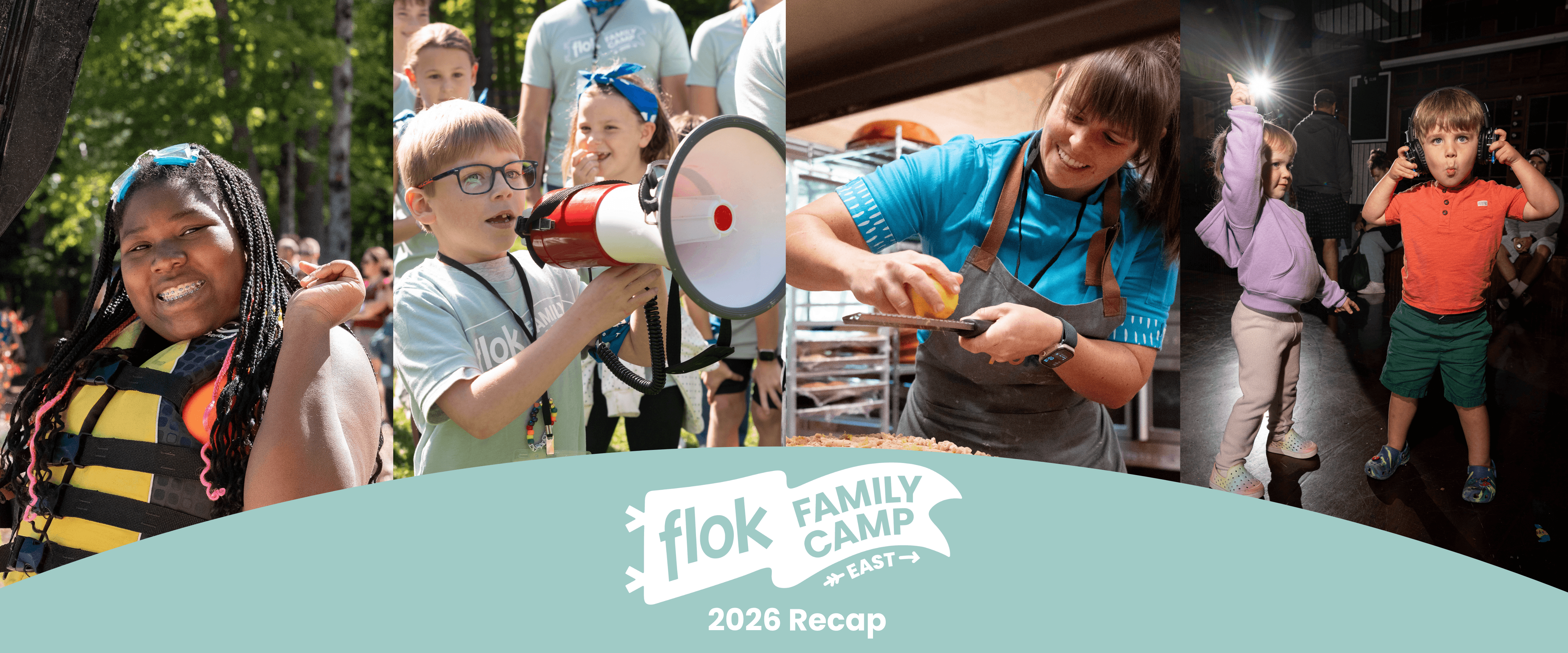
For one weekend in September, 180 campers gathered on the shores of Lake Winnipesaukee for the third annual flok Family Camp East. Held at Camp Belknap in Tuftonboro, New Hampshire, this was our largest East Coast camp yet: we were thrilled to welcome 20% more campers compared to last year. Individuals and families representing six metabolic conditions traveled from 25 states to get to camp this year, some making long journeys from across the country.
There were capsized sailboats, a silent disco, homemade pickles, and more laughs than we could count. But as in years past, what campers talked about most was the feeling of being surrounded by people who simply understand.
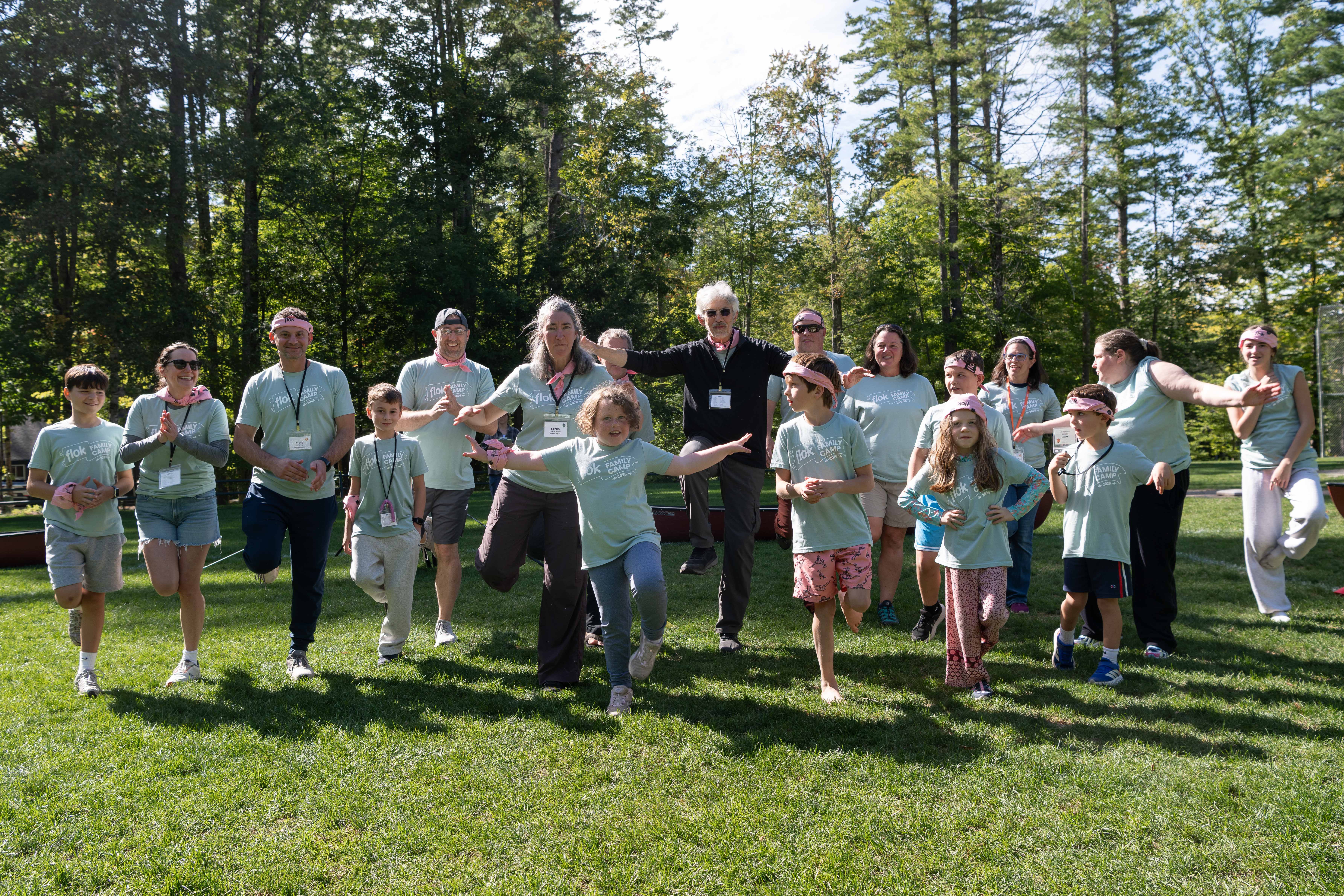
A Place Where We All Have a Similar Something
For many in our community, managing an IMD can feel like carrying something alone. At camp, it becomes the thing everyone has in common.
“There is a PKU mom who wrote the book Everybody Has Something. The beauty of flok Family Camp is that our families have the same ‘something,’” said Jill Elkins, mom of a 13-year-old with PKU. “This event allows families to bond over the things that we deal with regularly, which benefits the mental health of all those that get to attend — individuals with this diagnosis, siblings, and caregivers.”
For kids, the experience of being around people walking a similar path can be life-changing. Ciana McCarley’s 8-year-old daughter has classical PKU. Camp East was the first time they’d attended a flok Family Camp, and it was also the first time her daughter had met another person with her condition.
“My favorite part of the whole experience was meeting so many wonderful people and watching my daughter connect with other kids who have PKU. It’s not something she gets to experience in her everyday life,” said McCarley. “I also loved that camp included people of all ages, not just children. Being able to meet teenagers and adults who have PKU was just as important. It gave my daughter the chance to see that there are other people who have grown up dealing with the same things she does.”
Caregivers feel it too. “Unless you live with PKU or have a family member who does, I don’t think you can fully understand how much it affects everyday life. Something as simple as going to a birthday party, eating at a restaurant, or even having dinner with family can become stressful. There’s always something to think about, plan for, or explain,” said McCarley. “As parents, we’re constantly trying to make sure we’re doing everything we can to help [our kids] while also letting them have as normal of a life as possible. Being able to spend time with people who understand all of that without needing an explanation gives everyone a chance to just relax, have fun, and BREATHE for a change.”
“Being able to spend time with people who understand all of that without needing an explanation gives everyone a chance to just relax, have fun, and BREATHE for a change.”
— Ciana McCarley
Food Without Worry
Ask parents what they love most about camp, and many say the same thing: not having to think about food. A weekend when they don’t have to source supplies, calculate phe, or cook separate dishes means they can sit down and enjoy meals together without all the worry. That’s why our kitchen is at the heart of the weekend.
This year’s culinary team was led by chef Molly Atkins, who returned after her debut at Family Camp West 2026, along with chefs Ann Marie Stauber and Madeline Dwight. They were supported by registered dietitians Suzanne Hollander and Erin MacLeod (a flok Board and Scientific Advisory Board member), as well as two registered dietitians who now work for BioMarin, Eileen Mahoney and Katie Potter. This incredible team worked together to make sure every dish was delicious — and that meals worked for every camper.
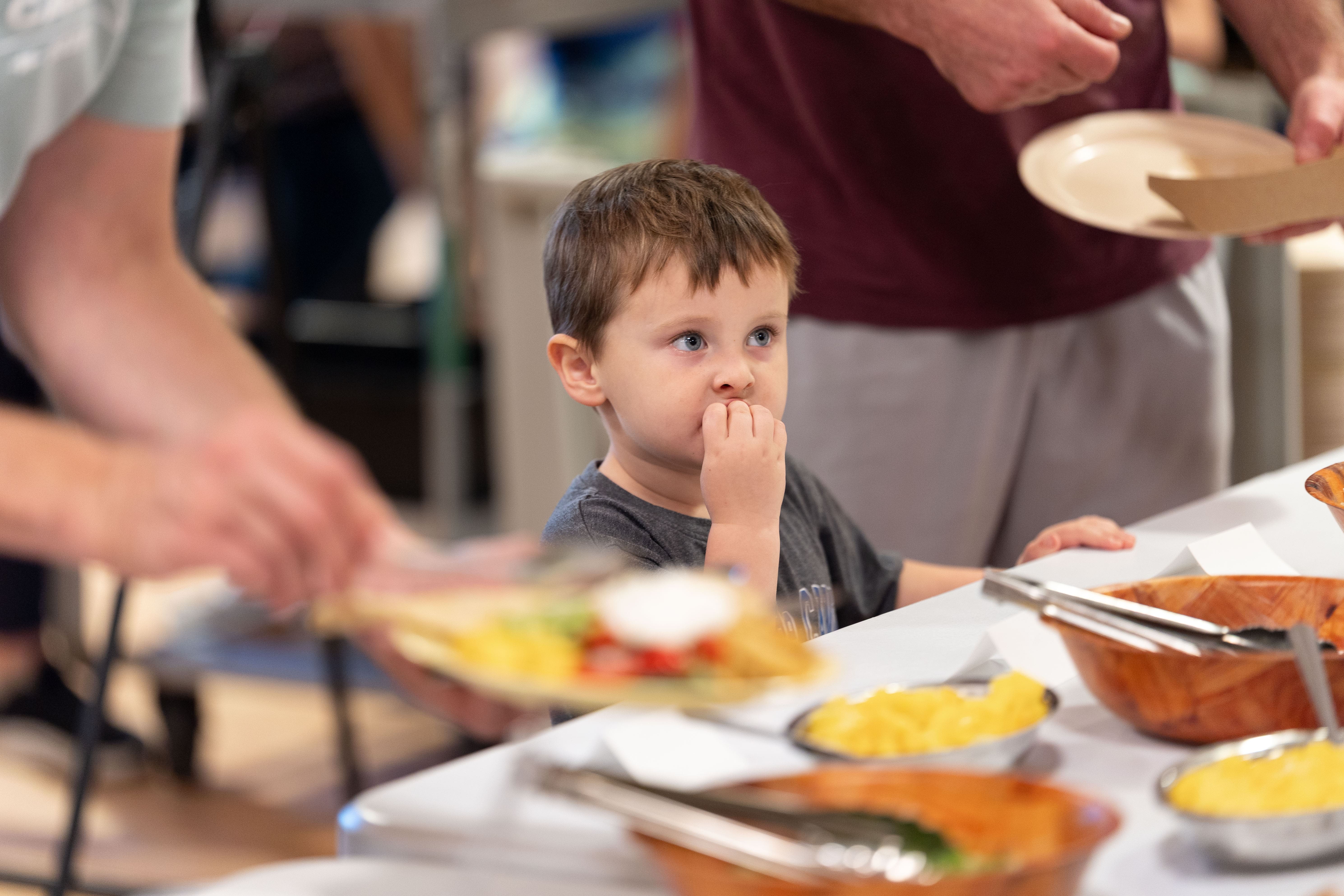
For parent Shelly Keogh, the impact was deeply personal. “It’s almost indescribable. To see my son be able to eat food without having to worry, for him to eat the same thing as his peers for once. For him to watch other children drinking formula and talking openly about their PKU. It’s priceless,” she said.
“The beauty of flok Family Camp is that our families have the same ‘something.’”
— Jill Elkins
Several cooking workshops let campers get hands-on, making pickles and “cookie pizzas.” The flok camp cookbook with detailed nutritional information lets families make their favorite camp meals back at home.
Science Night and The flok Together Show
Camp is also a place to learn. At Science Night, Dr. Shawn Christ, a member of flok’s Scientific Advisory Board, walked families through three of the brain’s functional networks and talked about how PKU-related changes in brain chemistry can affect the way they work.
Dr. Daelyn Richards, a flok Board and Scientific Advisory Board member, shared her own path through medicine: including what first drew her to studying genetics and metabolic disease, her early years doing gene therapy lab research, and what the IMD community has taught and given her.
Many attendees said that hearing about the work being done in the scientific fields that affect their day-to-day lives gave them hope. “Science Night showed me how much research is being done and how fast things are moving. It made me feel very positive,” said Shelly Keogh.
“Science Night showed me all the different studies that are happening not only for PKU patients but carriers as well. Understanding different ways to speak with providers that don’t have a lot of knowledge on PKU,” said another attendee.
“Science Night showed me how much research is being done and how fast things are moving. It made me feel very positive.”
— Shelly Keogh
Campers also got a treat: the premiere screening of The flok Together Show. The first episode follows three adults with different protein tolerances as they navigate menus and share their strategies for making their low-protein diet work while traveling around Portland, Oregon. Another episode featured gene therapy work being done by Dr. Michael Martinez and OHSU PhD candidate Laura Young, who joined a live Q&A.
Plenty of learning happened outside of these educational sessions, too. Families discovered new formulas and medical foods. And several attendees said that information they learned at camp will help guide conversations they have with their care teams back home.
Camp Traditions and New Adventures on the Water
Being in the great outdoors comes with occasional surprises. On the lake that weekend, the wind was up, and several of the small sailboats campers took out capsized. Thankfully, the skilled Belknap team was on hand to come to our rescue, and the mishaps gave us something to laugh about around the campfire. Paddleboarding, kayaking, canoeing, and a boat cruise were all a bit calmer, and dozens of campers hit the water, including some brave water-skiers as young as 8.
Back on land, families enjoyed archery, the climbing tower, and crafts, all led by the wonderful Belknap staff. At the flok Olympics, we even canoed on land, with participants ranging from less than 1 to 74 years old. Special thanks to Justin Derting, who led both the Olympics and teen activities. Justin worked at Family Camp West for years, and his family has always made the trek east, too. As always, the silent disco was a hit.
Camp Belknap has been welcoming campers since 1903 and this year celebrated its 123rd summer, making it one of the oldest continuously operating camps in the country. One of its most treasured traditions is nightly Vespers, a quiet, contemplative gathering in the woods led by a speaker. This year, one Belknap staff member shared his attempts to master a tricky bugle call and his realization that sometimes perfection isn’t the goal. flok CEO Jeb Haber read aloud a recommendation letter he’d written for Dr. Richards, honoring her commitment to and compassion for our community.
Better Together
The value of gathering in person isn’t limited to campers. Members of the team analyzing data from flok’s Signal Study met face to face to discuss next steps, led by Development & Analytics Program Manager Jeff Schleuter and other flok team members, Sarah Chamberlin, Michael Sitler, and Jeb Haber. They were joined by collaborators Dr. Christ, Dr. Richards, Dr. Sacharow, Dr. Martinez, Laura Young, and Erin MacLeod.
The community fair brought together partners, including New England Connection for PKU and Allied Disorders, whose support for scholarships helped regional families attend camp. Our partners make camp possible. We’re grateful to BioMarin returning this year as the presenting sponsor: one third of our campers benefited from free or sponsored registration that support made possible.
Our community partners aren’t the only ones who stepped up to support camp: through gifts and matching donations, we raised more than $27,000 to support our programs, including flok Family Camps. Thank you to every community member who contributed to this amazing achievement. Your investment in our community is truly appreciated.
Maridith Kasza, an adult camper with PKU, put it well: “flok Camp is a place where I can continue building relationships, learn about new science and research, reconnect with old friends, and make new ones. But more than anything, flok Camp gives me the experience of not having to explain myself every day like I often do in the real world. There’s something really special about being surrounded by people who understand without needing an explanation. Being at flok Camp is an experience I wish everyone living with an IEM could have.”
“There’s something really special about being surrounded by people who understand without needing an explanation.”
— Maridith Kasza
A heartfelt thank you to Camp Belknap and its outstanding team for their leadership, traditions, and warm hospitality.
Save the dates: Camp West is scheduled for June 3–6, 2027 and Camp East returns September 16–19, 2027. Subscribe to flok’s newsletter and follow us on Facebook, LinkedIn, and Instagram for registration details in early 2027.