
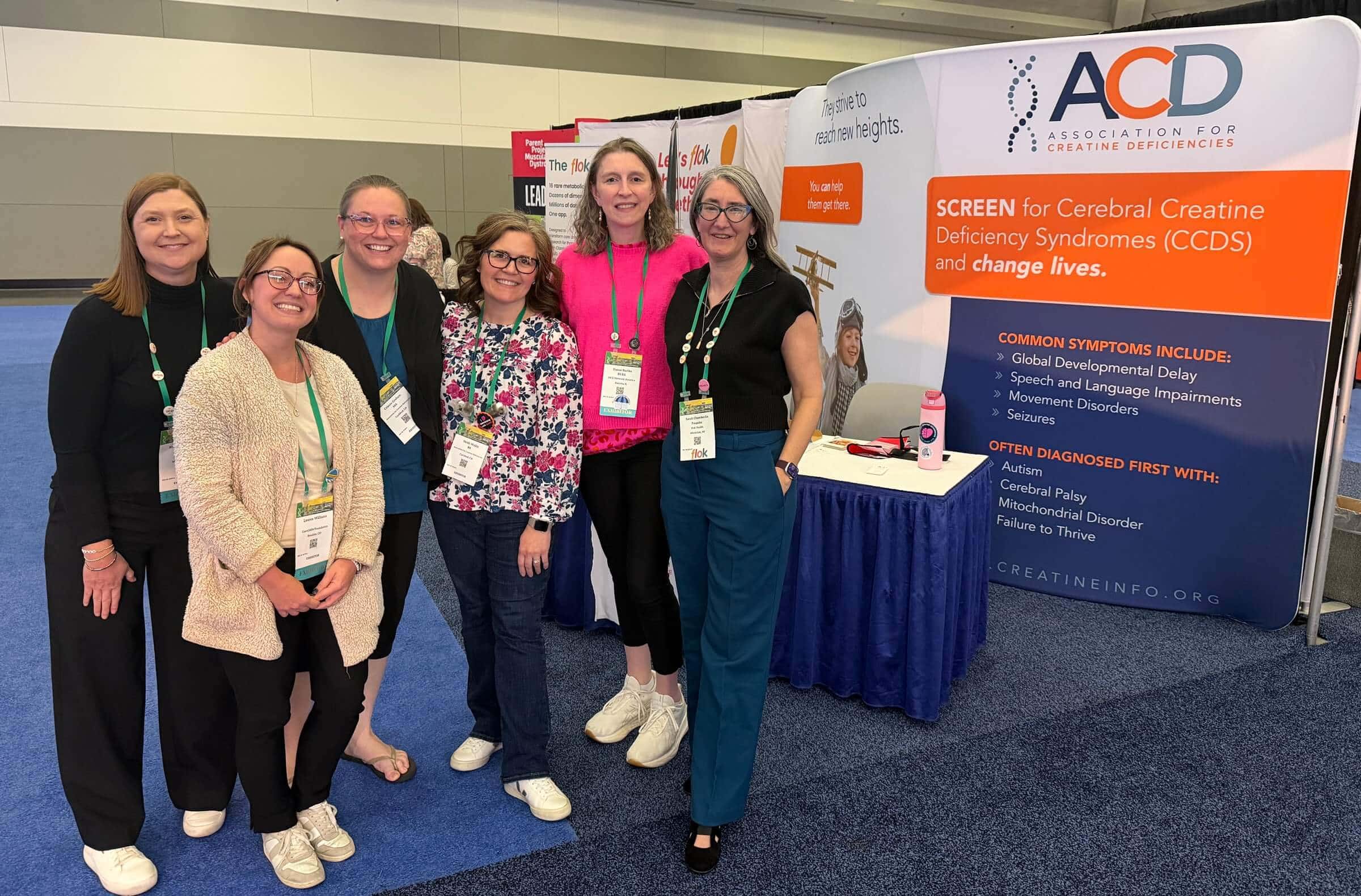
flok’s Chief Program Officer Sarah Chamberlin and Director of Community Engagement Kristen Vanags attended the American College of Medical Genetics and Genomics (ACMG) 2026 Annual Clinical Genetics Meeting in Baltimore. It was an incredible few days of discovery, learning, and connection for the metabolic community.

From emerging data in clinical trials to updates on the federal policy landscape surrounding medical nutrition access and newborn screening, the conference highlighted both progress and ongoing challenges. Sessions also explored how trial discontinuation can impact individuals and families living with metabolic conditions, underscoring the importance of continued collaboration across industry and community to address unmet needs.
The sessions and poster presentations were both informative and inspiring. Below are a few highlights from the conference:
Strides in Early Detection of Rare Metabolic Conditions
Research presented at ACMG highlighted new approaches to improving newborn screening and early detection for several metabolic conditions.
- Improved HCU detection: Researchers from the Department of Human Genetics at Emory University School of Medicine demonstrated that adding second-tier testing of newborn screening bloodspots—measuring total homocysteine, methylmalonic acid, and 2-methylcitrate—can significantly reduce false positives while improving detection of Homocystinuria.[1]
- Predicting PKU severity: A study from ARUP Laboratories and the University of Utah found that newborn screening phenylalanine-to-tyrosine ratios may help predict PKU severity early and assist in differentiating between PKU and hyperphenylalaninemia.[2]
- Glutaric Acidemia type 1 in the Menominee Nation: Researchers from the Medical College of Wisconsin identified a significantly higher heterozygote variant frequency for Glutaric Acidemia type 1 in the Menominee Nation compared with general population estimates. These findings may help inform genetic carrier screening and community education efforts.[3]
- Incidental diagnosis of Citrullinemia Type 1: A case study from WMC Health, Maria Fareri Children’s Hospital, and New York Medical College described the incidental diagnosis of Citrullinemia type 1 in a pregnant woman presenting with liver failure and elevated ammonia levels. The finding highlights the importance of metabolic and genetic evaluation in symptomatic pregnancies, and the need for earlier detection in newborn screening.[4]
Biomarker Home Monitoring Updates
Researchers also shared promising developments in non-invasive biomarker monitoring, which could help people manage metabolic conditions from home without delays in results.
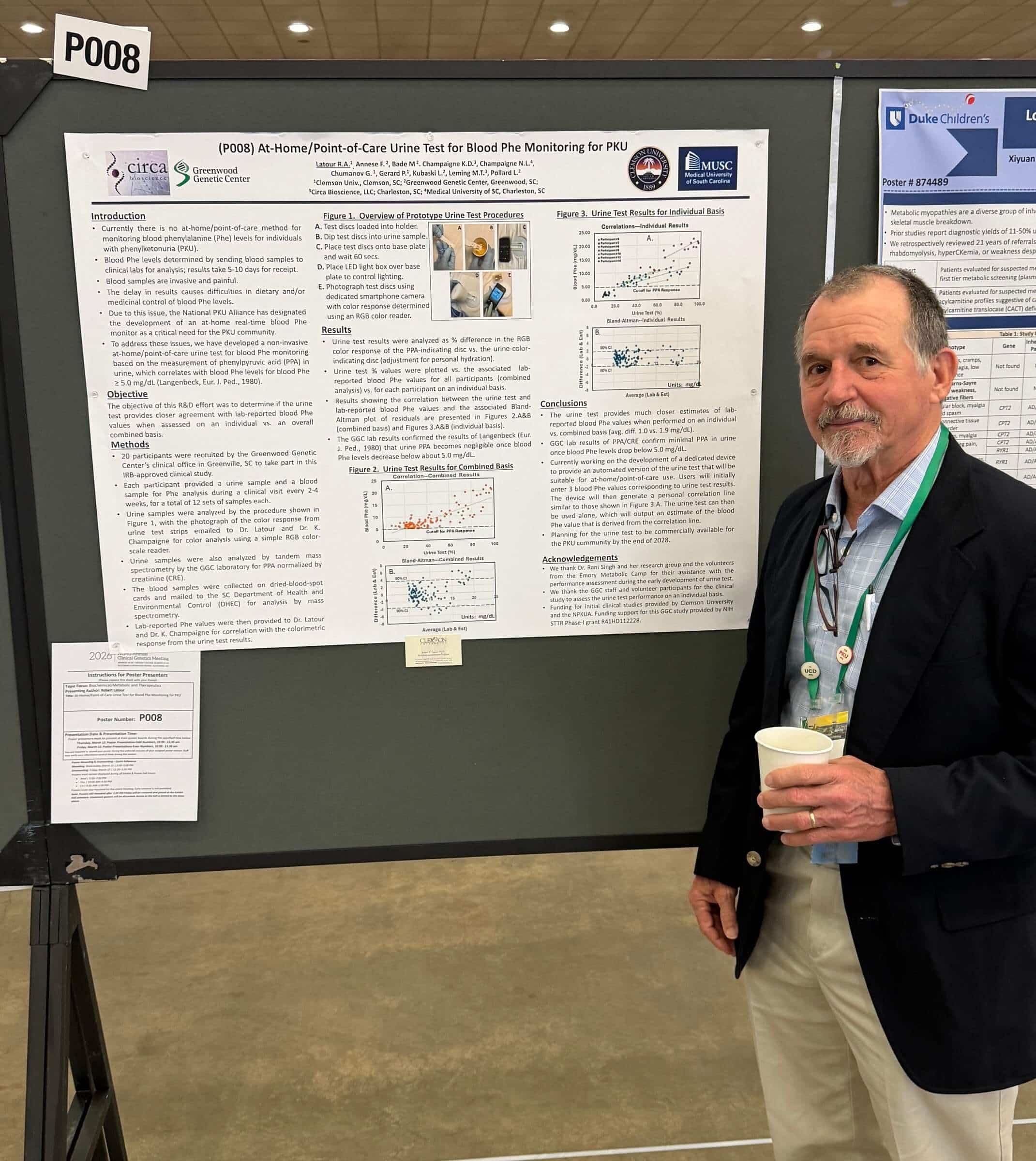
- Urine biomarker for PKU: Circa Bioscience presented findings from an IRB-approved study examining phenylpyruvic acid in urine as a biomarker that correlates with blood phenylalanine levels. Once a correlation line is established with blood phe, the urine test may provide a non-invasive way to estimate blood phe levels. The test could be commercially available in 2028.[5]
- Ammonia breath test for UCDs: Enhance Health’s (formerly Enhance Diagnostics) presented an IRB-approved study evaluating a non-invasive breath test designed to estimate blood ammonia levels in individuals with Urea Cycle Disorders (UCDs). Findings show that ammonia levels decreased after Ravicti use, and breath measurements appeared to reflect elevations of ammonia when participants felt symptomatic. Larger studies are needed before the technology can reach commercial use.[6]
See flok’s BioMarker Home Monitoring article and stay tuned as we work on an updated version tracking these technologies as they move closer to market.
New Clinical Trial Data Released
Several sessions also shared encouraging updates from ongoing clinical trials across metabolic conditions, including therapies for HCU, PKU, and UCDs.
- HCU and Pegtibatinase: In Phases 1 and 2 of Travere Therapeutics’ COMPOSE study, participants had rapid, sustained reduction of blood homocysteine levels below the therapeutic threshold, with some even achieving normal blood levels. They are now recruiting for their Phase 3 HARMONY study which includes adolescents.[7]
- OTC and DTX301 AAV8 Gene Therapy: Ultragenyx Pharmaceutical Inc. announced positive results from its Phase 3 Enh3ance Study of DTX301 AAV8 Gene Therapy for Ornithine Transcarbamylase (OTC). Treated patients had a significant reduction in blood ammonia after 24 hours compared to the placebo group.
- PKU and Repinatrabit (JNT-517): In a Phase 2 study led by Otsuka Pharmaceutical, adolescents with PKU who received Repinatrabit showed a clinically significant reduction of blood phe levels. A Phase 3 study is actively recruiting and underway.[8]
Conferences like ACMG remind us how much progress is being made across genetics and metabolic care, while fostering collaboration to move this work forward. We’re grateful for the opportunity to attend and bring these insights back to our flok community.
References
1. Wittenauer, A., Hall, P., & Wilcox, W. (2026, March). Decreasing false positive newborn screens for disorders of homocysteine metabolism using CLIR tools and second tier testing [Poster presentation]. ACMG, Baltimore, MD.
2. Hobert, J., Pasquali, M., Stebbins, B., Longo, N., & Andrews, A. (2026, March). Newborn screening Phe/Tyr ratio is an early predictor of severity of PKU [Poster presentation]. ACMG, Baltimore, MD.
3. Kelso, C. L., Kopesky, J., Waukau, J., Awonohopay, J., LaPean Kirschner, A., Geurts, J., Rein, L., Baker, M., Broeckel, U., Schwoerer, J. S., & White, A. L. (2026, March). Glutaric acidemia type 1 (GA-1) in the Wisconsin Menominee Nation [Poster presentation]. ACMG, Baltimore, MD.
4. Garizio, G., Niemynski, D., Rojas, N., Mofidi, S., & Kronn, D. (2026, March). Incidental identification of citrullinemia type 1 through carrier screening post liver transplant [Poster presentation]. ACMG, Baltimore, MD.
5. Latour, R. A., Annese, F., Bade, M., Champaigne, K. D., Champaigne, N. L., Chumanov, G., Gerard, P., Kubaski, L., Leming, M. T., & Pollard, L. (2026, March). At-home/point-of-care urine test for blood Phe monitoring for PKU [Poster presentation]. ACMG, Baltimore, MD.
6. Leming, M., Nguyen, C., Goforth, C., Chumanov, G., & Latour, R. (2026, March). Simple breath test to monitor blood ammonia levels in patients with a urea cycle disorder [Poster presentation]. ACMG, Baltimore, MD.
7. Ficicioglu, C., Ben-Omran, T., Levy, H., Maillot, F., vom Dahl, S., Wong Po Foo, C., & Thomas, J. A. (2026, March). Pegtibatinase, an investigational enzyme replacement therapy, for the treatment of classical homocystinuria (HCU): Design of the HARMONY Phase 3 study [Poster presentation]. ACMG, Baltimore, MD.
8. Harding, C. O., Longo, N., McNutt, M., Muntau, A. C., Singh, R., Vaughn, T., Schluep, H., Li, W., Davis, T., Idso, J., & Leal-Pardinas, F. (2026, March). Design of a randomized, double-blind, placebo-controlled, Phase 3 efficacy and safety trial of repinatrabit in adults with phenylketonuria [Poster presentation]. ACMG, Baltimore, MD.